Showing posts with label Jennifer Jangles. Show all posts

Friday, August 7, 2015

Wonky Striped Improv Quilt Block


Hello, Hello, I'm going to start a new weekly post on the blog featuring quilt blocks. Every Friday I will feature a new quilt block, I got a little carried away with my first few blocks and the tutorials. I even sewed up a mini quilt with nine wonky blocks. Wonky blocks are my favorite for a couple reasons. The first reason I like wonky blocks is that there no measuring. The second, they are a great way to use up scraps. The third, which kind of goes back to measuring, is that you can make them any size you would like. 

So were going to start today with the striped block. Some quilters call them strings. The blocks in my mini quilt are all 4 inches when finished, just in case you want to make them the same size. In this case I wasn't using small scraps so I cut some squares to roughly 6 inches in size to allow for seam allowances, etc.


I stacked up two of the blocks and cut them in to four strips. You could cut them straight or at an angles. Yay for wonky blocks! It doesn't matter.


Sew two strips together with right sides facing and a 1/4" seam allowance. Do this for as many sets as desired.

                                     
Press them open In my case I wanted every other strip to be white so I had to put them together in order. If you're going scrappy, then the strips can be sewn any way you like.


Press all of the seams open and trim the block to the desired size you would like. I'll be next week with a new wonky quilt block. In the meantime, be sure to follow me on Facebook, Pinterest, and Instagram, I'll be showing you more striped or string blocks this week. If you sew any up your self, be sure to tag me #jenniferjangles so I don't miss it.

Have a great day,


Visit my Website, Etsy Shop, Blog, Facebook

Friday, July 3, 2015

Insect Tea Towels


I mentioned the Stetson Mansion Quilt Show in my last post about my Reversible Place Mat Tutorial.
Judy Hansen down at the Quilt Shop of Dealand puts on a HUGE quilt show every summer at the Stetson Mansion. It runs July 18th-30th this year. Every room is decorated in a theme and is filled with quilts and other sewn items. The kitchen is going to be filled with insect themed picnic items this year. She's got my BugaPalooza fabric in her shop and so she asked me to sew up some items. Tea towels were on my list.


These were super fun to sew up and I guarantee you'll be seeing more tea towels and tea towel tutorials in the future.

 Here is where you can read more about the Mansion and Quilt Show. And if you are lucky enough to make it to the show, then you should stop by her shop too.


Have a great day,


Visit my Website, Etsy Shop, Blog, Facebook

Friday, May 22, 2015

Picnic Blanket with BugaPalooza Fabric


It's finished! If you follow me on Instagram or Facebook, you've probably seen some glimpses at the Bugapalooza Picnic Blanket I have been working on. What's a picnic blanket? It's a quilt you take on picnics, or to the beach, but I know you already know that part. :)


Some folks like to use a waterproof backing, or a twill or canvas backing to make the blanket heavier. I decided to keep mine all cotton, but I choose a heavier and stiffer batting to help weigh it down a little more. Before you ask, I have no idea what kind of batting it was, it was in my studio from another project and it wasn't labeled, I just liked the weight and went with it.


Here's how I pieced the quilt top. I made this quilt half yard friendly. I used eight different half yard cuts of BugaPalooza fabric to cut the inner blocks. The inner blocks are 9" square and there are 36 of them sewn together, six rows of six.


The cream dot borders are 4.5" in width. To cut these the most efficient way I could, I cut a one yard piece of fabric in to 1/8 yards strips and then sewed two strips together. The seam of the strip lines up with the middle seam of the 36 blocks.

Then that nice big border(almost 10" wide) was added to all sides. It took me 2.5 yards of border fabric. There are four borders to one width of fabric. Two opposite sides were sewn on and trimmed and then the two remaining border pieces were sewn on. My quilt top was finished, it went together super fast.


For quilting I went with my favorite superior thread. King Tut #934 Nile Delta It's yellows and lime green. It blends nicely with all of the colors, I used it on a lot of my quilts.

I did a little meandering through the center and then did some free motion scallops to mimic the scallops on the fabric border. When it came to quilting the border, I loosely went around the flowers and insects.


Last was sewing on the binding. It's Memorial Day weekend, so I will definitely be putting this picnic blanket to use!

And if you want to make one yourself, enjoy free shipping all weekend in my web store. Enter the coupon code FREESHIP. (US orders only, expires Monday May 25th at midnight)

Here's the breakdown for cutting fabric again:
36 squares measuring 9" x 9"
4 Cream Dot Strips measuring 4.5" x 60"
4 Border pieces measuring 90" in length


Have a great day,


Visit my Website, Etsy Shop, Blog, Facebook

Thursday, April 30, 2015

How to Embroider with the Cross Stitch


Today's stitch is an easy one. It's the cross stitch. It's basically two running stitches that are criss crossed. The only reason I added it to the sample is because there are a couple of ways to stitch multiples of them. Either way works, you can choose which is best for you.


First of all, start at the bottom left point of the "X" and bring your needle up. Send the needle back down on the opposite side of the line. 


Now this is where you can choose the method of stitching you like. You can continue across your row, stitching all of the diagonal lines the move from left to right or you can do one "X" at a time.  In the above photo I went ahead and stitch the line from right to left next and then moved on to the next "X". 


If you're doing a whole row, sometimes it's easier to stitch all of the left to rights and then go back and stitch the right to lefts. It will also insure that your right to left floss will be on top across the whole row. This gives your cross stitch a more consistent look.


Your sampler should be finished at this point, woo hoo! I really hope you had fun. Send me photos of your samplers or other projects you've stitched. Tag me on instagram #jenniferjangles with them or post them on my Facebook page. I can't wait to see what you've stitched up!

Have a great day,


Visit my Website, Etsy Shop, Blog, Facebook

Wednesday, April 29, 2015

How to Embroider, French Knots


The french knot.... I will admit this one took me some time to master. It can be tricky, but with practice you'll get the hang of where your hands should be and it will then turn in to something easy to do.

I choose to stitch my knots in purple. Here we go...


First, send the needle up from the bottom on one of the marked spots. Pull the floss all of the way through until the knot hits the fabric.


Approximately an inch above where you're french knot will be, hold the needle in one hand and with your other hand wrap the floss around the needle three times.


Here is the most important part, the hand holding the floss should continue to hold the floss, pull the floss pretty snug. The floss will slide down the needle, continue to keep the floss snug. Start pushing the needle into the fabric. At this point it should look like a knot on your needle, see the photo?


Here's a close up. If it doesn't look like this, your knot isn't going to turn out well, trust me on this. I have had to start over at this point many times.


If your needle looks like this, then send the needle all the way through the fabric. Pull the floss all the way through and you should be left with your knot.


Move on to the next one and try another.


There are loads of knots on this sampler so you'll get the hang of it and be ready to stitch anything.


Here is a graphic as well.


One more stitch and we'll have this sampler wrapped up, yay! Hope you're having fun,


Visit my Website, Etsy Shop, Blog, Facebook

Tuesday, April 28, 2015

How to Embroider with the Satin Stitch


How's the sampler coming along? Were changing floss colors today, yay! Grab your green floss and we're going to do the satin stitch. 

          
The satin stitch is great for filling in areas with color. The satin stitch is basically running stitches that are side by side. Start by pushing your needle up through the fabric on the line. Push the needle back through on the line directly across from where you came up. 


You next stitch will go right next to your first stitch. Be sure your needle is coming up and going down on the lines to keep the shape of the leaf. 


Continue stitching until you reach the other side of your leaf. Stitch all of your leaves this way. If you feel like your leaves need an outline to give them better shape you can always go around the outside with a back stitch. 


Here's the back, I just slid my needle through the floss on the back of the leaf and then trimmed it.


I used three strands of floss and the back stitch to sew the vines for the leaves. Next, switch to yellow or whatever color you chose for your flower and do the satin stitch again for the center of the flower. The outside of the flower is three strands of floss and the running stitch. Finish up the flower and vines today because tomorrow were moving on to french knots.


Have fun stitchin'


Visit my Website, Etsy Shop, Blog, Facebook

Monday, April 27, 2015

How to Embroider with the Split Stitch


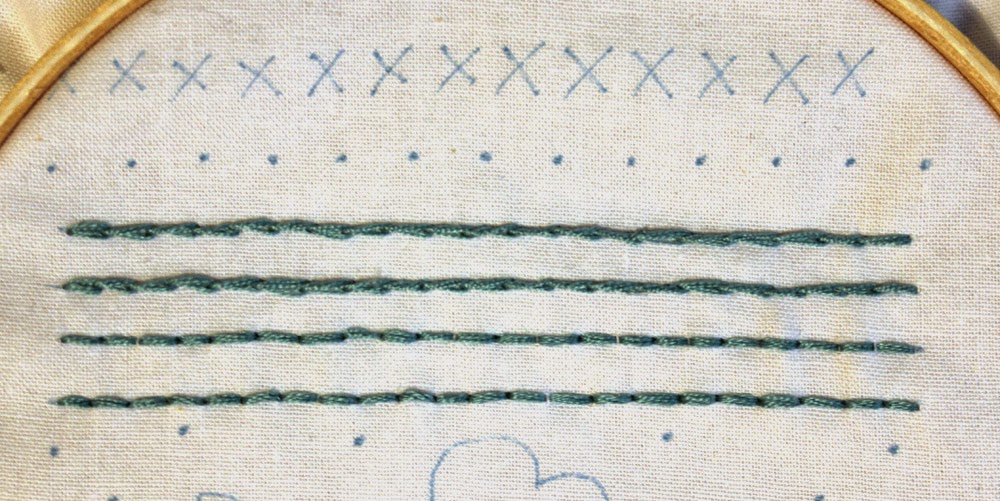
How's the sampler coming along? Were starting on our third stitch today, this one is called the split stitch. It's called the because you split the previous stitch as you go. I like to use this stitch on vines it's a very organic looking stitch to me.


First off, get your needle and floss ready. Start by making a running stitch.


From the bottom, send the needle up through the fabric and split the floss strands. The needle and floss will come up in the middle of the floss.  I've got a couple views of the needle here so you can see.


You'll notice the needle comes up through the floss towards the end of the prior stitch.


When I stitched my two rows of the split stitch I started both rows from the same end, that way the stitches would run the same direction.


Here's a diagram as well.


See yo tomorrow, we'll be working on the satin stitch.
Have a great day,
Jennifer

Visit my Website, Etsy Shop, Blog, Facebook
Pin It button on image hover